





 +60173309581
Does Your University Matter for Getting a Job in Malaysia? What Employers Actually Want in 2026
July 01, 2026
Mehmil
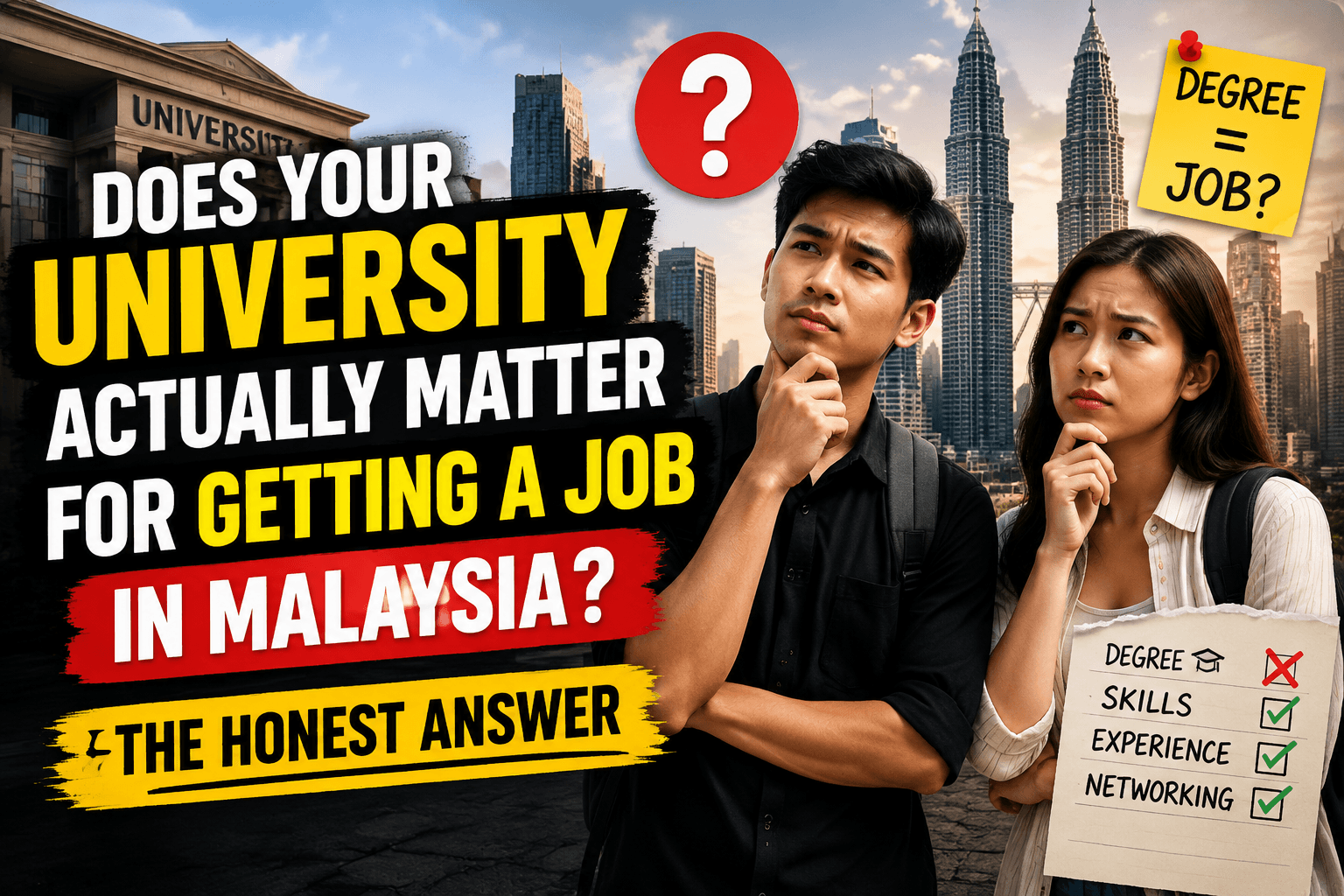
Every university open day will tell you that their graduates get hired into great companies.
What they won't tell you is how much of that is the university's doing, and how much is just down to the student.
Studying is an investment, and like any investment, you should be questioning what it's really getting you.
We're going to answer that honestly here.
Your degree opens the door, but it's not what gets you through it. Employers care a lot less about your scroll than you think, and a lot more about what you actually did during those three years.
If you're trying to figure out what really moves the needle for getting hired after graduation, this might change how you think about the whole decision.
The Uncomfortable Truth About "Which University" for Local Employability
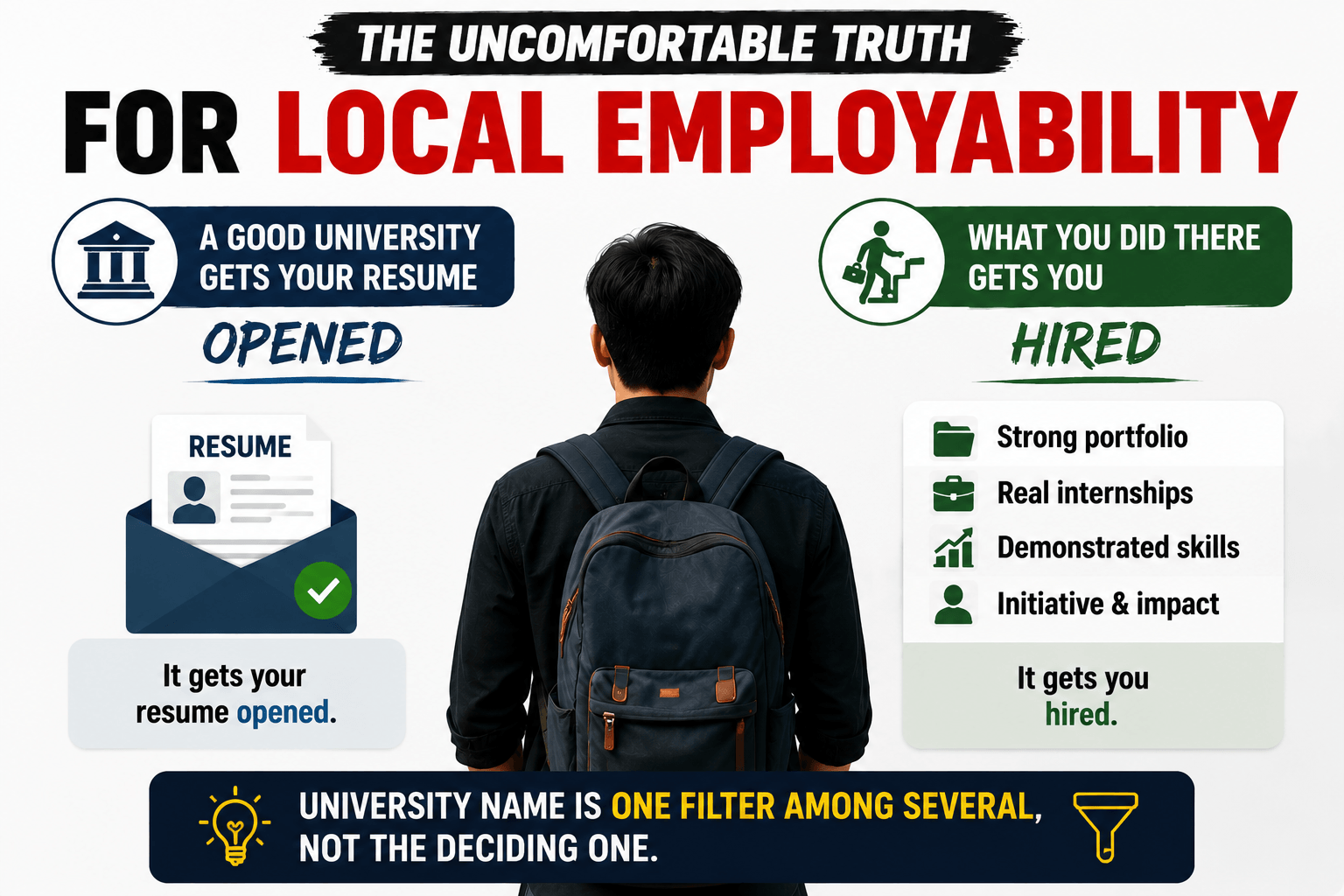
For local students, which university matters less than most marketing suggests, and what you did there matters more than most students assume.
A degree from a well-known university gets your resume opened. It does not, by itself, get you hired over someone with a strong portfolio, real internship experience, and demonstrated initiative — regardless of which university they attended.
You're competing against every other graduate from every other university, public and private, for the same entry-level roles, and increasingly, against international graduates too, in the same hiring pools.
University name is one filter among several, not the deciding one.
Where University Choice Actually Makes a Difference
University choice is not irrelevant; it just tends to matter in specific areas rather than across every career path.
Here are several areas where it can make a measurable difference:
1. Industry networks and internship access
Universities differ significantly in the strength of their industry partnerships. Institutions with stronger corporate links often provide more internship opportunities, employer engagement events, and direct recruitment pipelines.
Multiple graduate studies and employer surveys suggest that internship experience is associated with stronger employment outcomes and improved work readiness after graduation.
2. Reputation within specific fields
Employer perceptions are often field-specific rather than university-wide. In technology, for example, institutions such as Asia Pacific University (APU) and Multimedia University (MMU) have developed strong reputations through industry collaborations and computing-focused programs. APU has ranked highly in employer-based Computing and IT surveys in recent years, reflecting recognition within technology hiring.
As Malaysia's digital economy expands across AI, cybersecurity, software development, cloud computing, and digital services, demand for technology talent is expected to continue growing, increasing the importance of practical skills and industry exposure.
3. Government and public-sector recruitment
Certain public-sector pathways may show stronger representation from public universities because of long-established institutional networks and recruitment patterns, although this can vary across agencies and roles.
However, across much of Malaysia's private sector, employer research increasingly suggests that skills, practical experience, communication ability, and job fit can weigh more heavily than university category alone, although preferences for particular institutions may still exist in some industries and roles.
4. Graduate outcomes beyond headline employability rates
Malaysia's graduate employability rate has recently been reported at around 89–90%, according to Ministry of Higher Education data. However, these measures typically include a broader range of outcomes beyond full-time employment, such as further study and skills-development pathways.
Research also suggests that some graduates experience skills mismatches or work in roles that are not closely aligned with their field of study. While employability figures indicate that graduates are entering post-study pathways, they do not necessarily capture job quality, long-term career progression, salary outcomes, or alignment between employment and degree specialization.
What Employers in Malaysia Are Actually Hiring for in 2026: High-Demand Skills, Industries, and Graduate Trends
If you're choosing a university course today, the more important question is often not "Which university is better?" but "Which skills and specializations are employers actively paying for?"
Malaysia's hiring market is becoming more targeted. Employers are still hiring, but demand is increasingly concentrated in specific high-growth areas rather than broad graduate intake programs.
Recent hiring reports show strong demand in technology, digital transformation, finance, fintech, and shared-services roles. Around 44% of employers surveyed planned to increase hiring activity, but the trend is focused on capability-based hiring rather than large-scale expansion.
Where Hiring Demand is Concentrated Right Now:
| Sector | Common Roles Employers Are Hiring For Why | Demnd Is Growing |
|---|---|---|
| Technology & Digital |
Software Engineer, Full-Stack Developer, Cloud Engineer, AI/ML Engineer, Data Analyst, Cybersecurity Analyst
|
Enterprise digital transformation, AI adoption, cloud migration |
| Fintech & Financial Services |
Business Analyst Product Specialist Risk & Compliance Fintech Operations
|
Growth of digital banking and financial technology ecosystems |
| Shared Services / Business Process Services |
Finance Executive HR Operations Customer Operations Business Support
|
Malaysia's role as a regional operational hub |
| Data & Analytics |
Data Analyst BI Analyst Data Engineer
|
Increased use of business intelligence and data-driven decision-making |
| Supply Chain & Operations |
Supply Chain Analyst Procurement Specialist Logistics Planner
|
Regional trade growth and operational efficiency initiatives |
Four Things Students Should Take Away
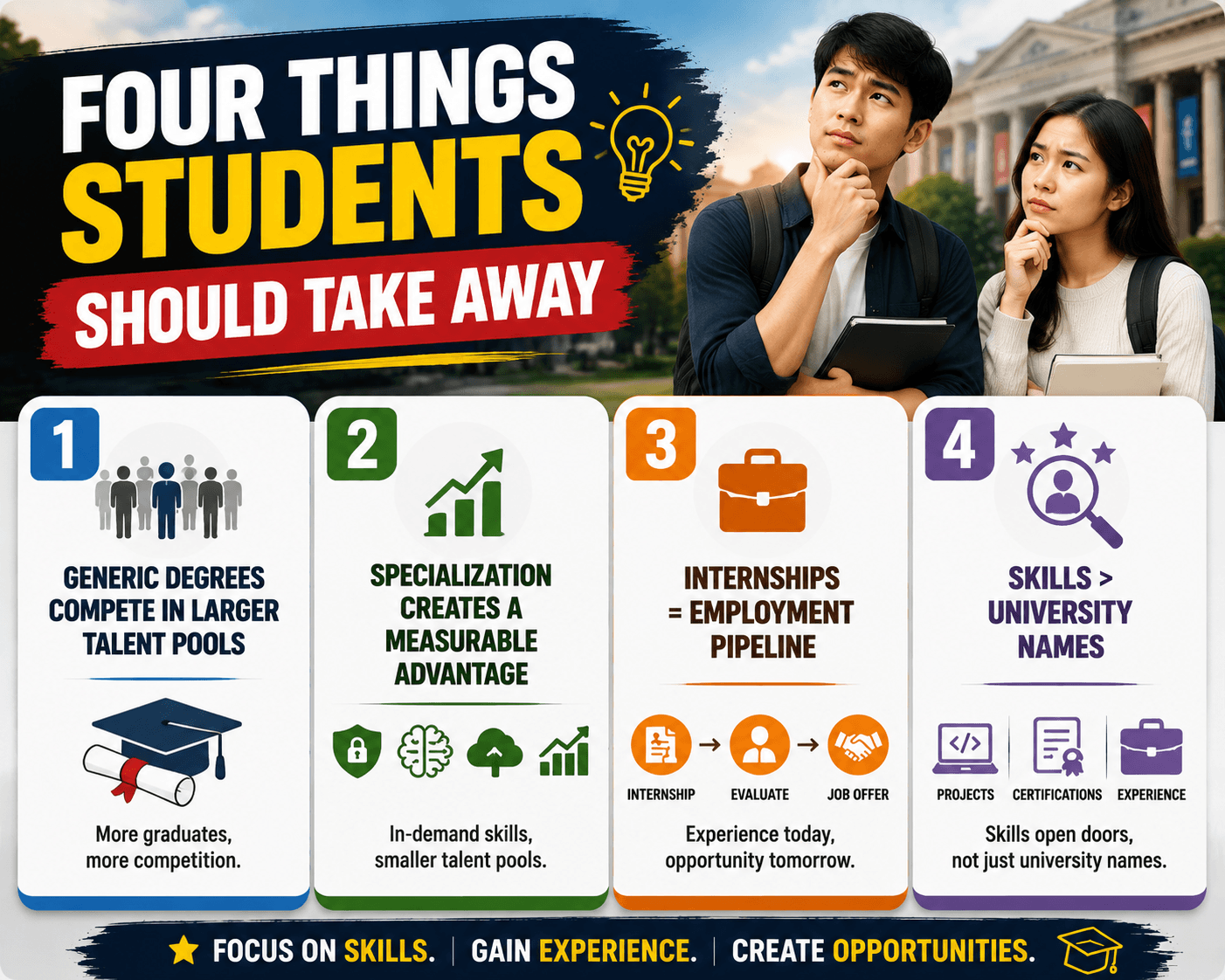
1. Generic degrees now compete in larger talent pools
A broad Business or IT degree without a specialization often places graduates in the largest and most competitive applicant group. Employers increasingly filter candidates based on practical skills and domain knowledge.
2. Specialization creates a measurable advantage
Fields such as cybersecurity, AI, cloud computing, data analytics, supply chain management, and fintech move graduates into narrower talent pools with lower competition and stronger employer demand. Current Malaysian technology hiring trends continue to show skills shortages in AI, cloud, cybersecurity, and data-related roles.
3. Internships increasingly function as an employment pipeline
One relevant internship can materially change a graduate's competitiveness. Employers frequently use internships to assess work readiness, communication ability, and technical capability before extending full-time offers.
4. Skills are becoming stronger filters than university names
Across much of the private sector, employers increasingly focus on whether graduates can demonstrate usable skills rather than relying purely on university branding. Portfolios, certifications, internships, projects, and industry exposure can become significant differentiators.
The practical implication
If you are deciding between courses, the sequence of importance increasingly looks like this:
Specialization + Internship Experience + Practical Skills > University Brand alone
University choice still matters, especially for networking opportunities and industry exposure, but choosing a clear specialization with real-world experience often has a greater impact on employability than choosing between two legitimate, MQA-accredited universities.
Common Mistakes Students Make When Choosing a University
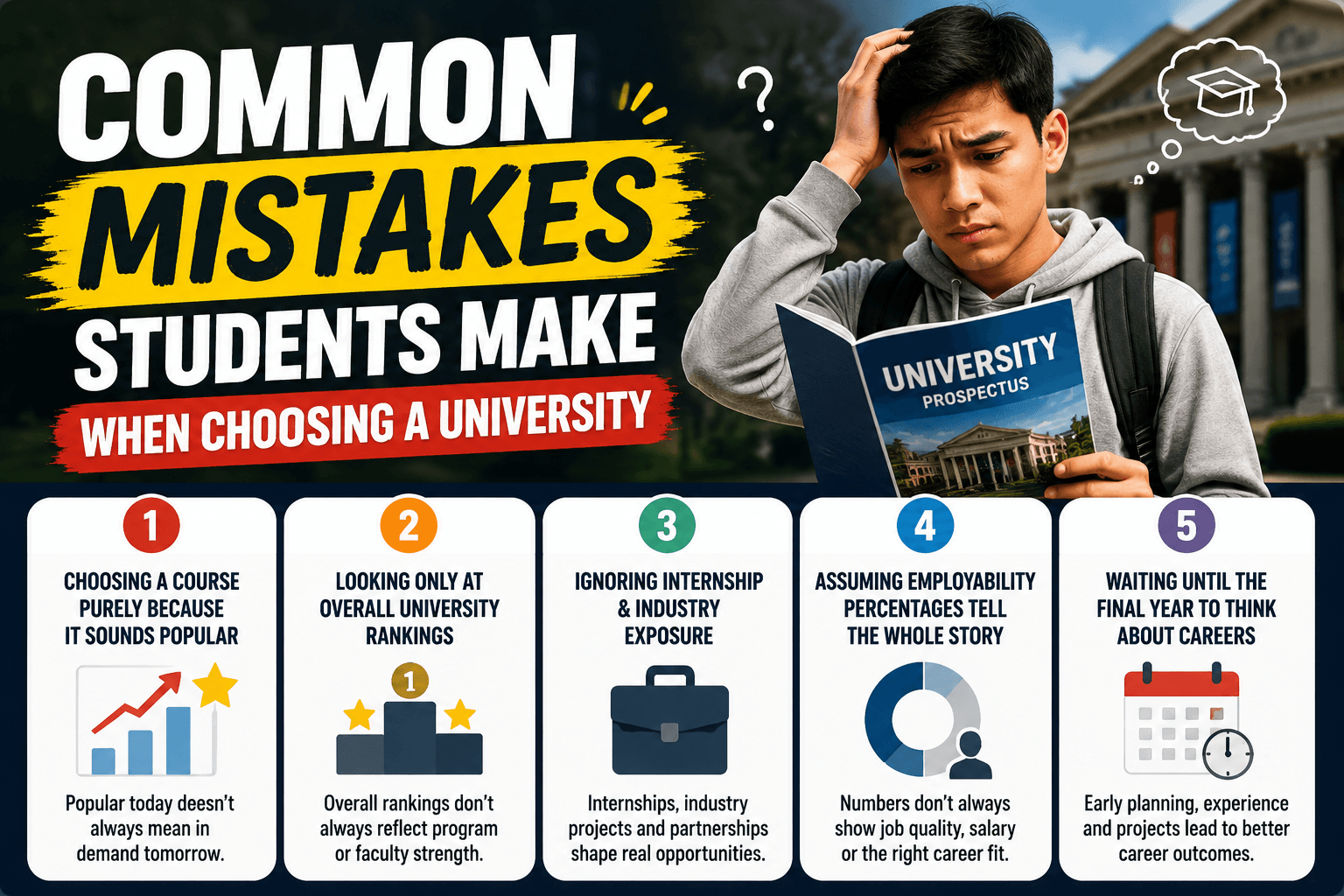
Choosing a university is one of the biggest decisions students and parents make, but many decisions are still based on assumptions rather than long-term outcomes.
Here are some common mistakes to avoid:
1. Choosing a course purely because it sounds popular
Fields with high student interest are not always fields with the strongest demand. Understanding where industries are growing can be more useful than following trends.
2. Looking only at overall university rankings
A university's overall reputation does not always reflect the strength of a specific faculty or program. Some universities may have stronger industry recognition in certain disciplines.
3. Ignoring internship and industry exposure
Students often compare tuition fees and rankings while overlooking internship access, employer partnerships, and industry projects that can influence career opportunities later.
4. Assuming employability percentages tell the whole story
Graduate employability rates can provide useful information, but they do not always explain job quality, salary outcomes, or whether graduates work in their intended field.
5. Waiting until the final year to think about careers
Students who build portfolios, gain experience, participate in projects, and complete internships earlier often enter the job market with stronger positioning.
A Practical Guide for Parents Choosing a University for their Children
For parents making university decisions with their children, it can help to think beyond rankings and tuition fees alone. The university experience today is increasingly about the opportunities surrounding the degree.
A university name can increase opportunities and improve access to networks, but it does not guarantee a job offer or career success.
While academic quality remains important, several factors can shape a student's exposure and career readiness during their university years:
What can Create Long-term Value During University?
| Factor | Why It Can Matter |
|---|---|
| Industry Connections | Universities with stronger industry collaborations often provide students with internships, company projects, guest lectures, and networking opportunities that create earlier exposure to employers. |
| International Pathways | Some institutions offer credit transfer options, dual awards, overseas partnerships, and exchange opportunities that can broaden academic and career possibilities. |
| Internship & Employability Support | Structured internship programs and career support services can help students gain practical experience before graduation. |
| Specialized Learning Pathways | Programs with clear focus areas such as AI, cybersecurity, fintech, business analytics, or supply chain management can align more closely with current hiring trends. |
| Exposure Outside the Classroom | Competitions, industry events, leadership programs, and student projects often help students build skills and confidence beyond academics. |
What Many Employers Increasingly Value
Across many industries, employers are not only looking at academic results. They are also assessing:
- Internship and project experience
- Communication and problem-solving ability
- Technical and digital skills
- Portfolios and practical work
- Initiative shown during university years
For parents and students alike, the question is often not only "Which university should we choose?" but also "Which environment will give the student the strongest opportunities to grow over the next three or four years?"
Bottom Line
If you're choosing between universities or courses, the goal is not simply to ask "Which university is best?" A more useful question is: "Which option gives me the strongest combination of skills, opportunities, and career exposure?"
University reputation can influence opportunities, but long-term outcomes are often shaped by what students build during their years there.
The most valuable university experience is not only earning a degree, but also gaining practical experience, developing specialized skills, building networks, and taking advantage of the opportunities available along the way.
The university can create opportunities; how students use those opportunities often determines where they go next.
Frequently Asked Questions
1. Does university ranking matter for getting a job in Malaysia?
University rankings can influence perception and initial opportunities, but employers also look at practical experience, skills, internships, and field-specific strengths.
2. Do employers in Malaysia prefer public or private university graduates?
Employer preferences often depend on industry and role requirements. Across much of the private sector, skills, experience, and job fit frequently matter more than university category alone.
3. Which university courses have better job prospects in Malaysia?
Demand currently remains strong in areas such as technology, cybersecurity, AI, cloud computing, data analytics, supply chain, finance, fintech, and digital business functions.
4. Is an internship important before graduation?
Yes. Internships provide practical experience, industry exposure, and often become pathways into full-time employment opportunities.
5. Does paying more for a university guarantee better career outcomes?
Higher tuition can sometimes provide access to additional resources, networks, industry connections, or international opportunities, but outcomes are also heavily influenced by student initiative and experience built during university.
6. What should parents look at besides university rankings?
Parents can also consider course specialization, industry partnerships, internship support, international pathways, graduate outcomes, and overall student development opportunities.
Kickstart your education in Malaysia
We'll help you find and apply for your dream university
You might be interested in...
- Top Actuarial Science Universities in Malaysia for International Students 2026
- Is an MBA Worth It? 5 Pros and Cons You Should Consider in 2026
- Choosing the right university and course in Malaysia
- Types of English Language Proficiency Tests in Malaysia
- 8 Good Study Habits For University Students
- Choosing Between Public or Private University in Malaysia: What is your choice?
- International Students Healthcare Guide in Malaysia
- How University Students Should Prepare For Work?
- Cost of Living in Malaysia for International Students 2026
- How Can International Students Work in Malaysia After Graduation